

Most people pack for the box; successful movers pack for the constant vibration of a 900-kilometre journey across the Australian interior. It’s a common mistake to assume that local moving techniques work for a long-distance haul, but the reality is that road stress is the primary cause of breakage. Finding the right packing tips interstate move Australia families can rely on is the difference between a fresh start and a box of shattered porcelain.
We understand that feeling overwhelmed by the sheer volume of items is natural. You want to be certain that your fragile goods are protected against climate shifts and rough roads while ensuring you don’t fall foul of strict state quarantine regulations. It’s about more than just filling crates; it’s about a professional system that prioritises security and ease of unpacking.
This article shows you how to master the “Transit-First” packing strategy to keep your belongings safe without a scratch. You’ll learn which heavy-duty materials actually work, how to stabilise internal loads, and the critical interstate-only steps you can’t afford to miss. This guide provides a clear, organised plan for a damage-free arrival at your new home.
Key Takeaways
- Adopt a “Transit-First” mindset by doubling your internal cushioning to withstand thousands of kilometres of road vibration across the Australian interior.
- Use expert packing tips interstate move Australia families trust, such as the “No Movement” rule, to verify your boxes are secure before they hit the highway.
- Replace basic labelling with a digital master inventory system to ensure you can find any item instantly among a full truckload of goods.
- Identify high-risk items like pianos that require specialist movers and learn why professional packing is vital for maintaining your insurance coverage.
Planning Your Transit-First Packing Strategy
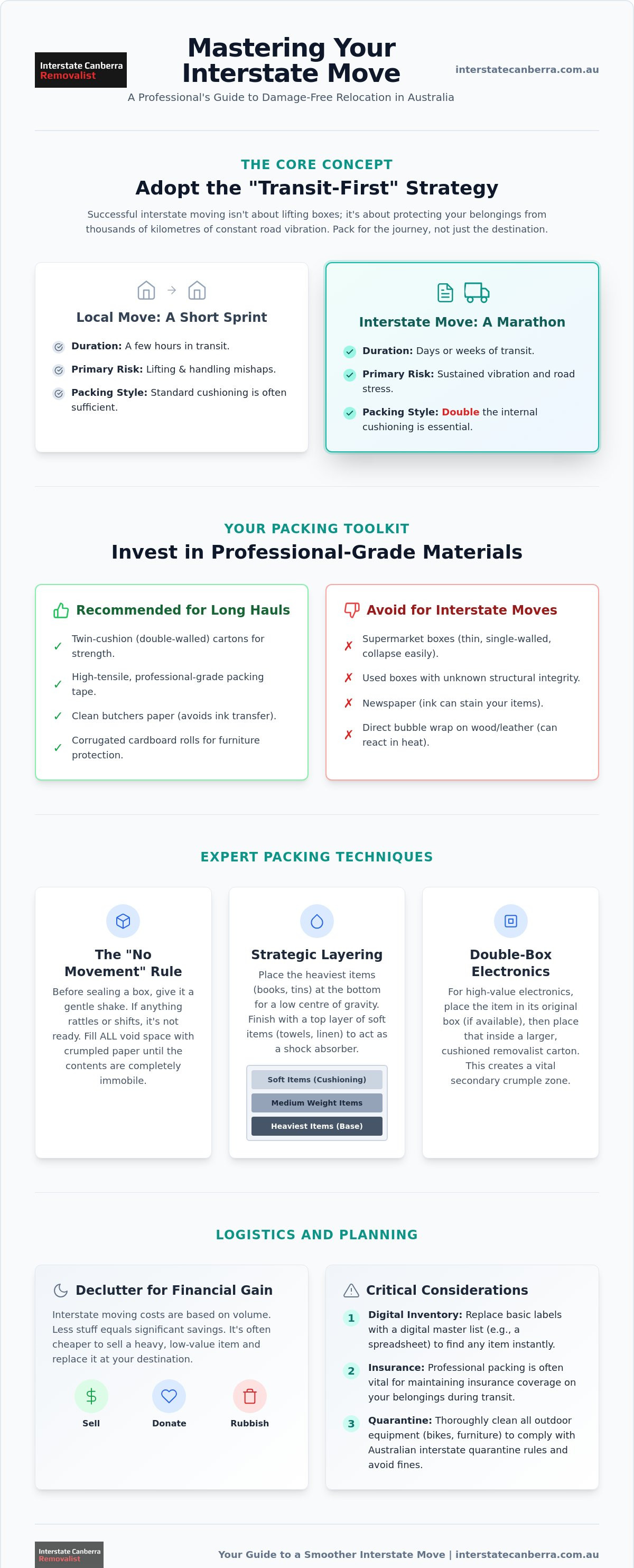
A successful interstate move starts with a mental shift. You aren’t just packing for a new house; you’re packing for a journey that could span thousands of kilometres. We call this the “Transit-First” strategy. This approach prioritises internal stabilisation because the primary threat to your belongings isn’t the lifting. It’s the constant, high-frequency road vibration experienced on Australian highways. While a local move is a short sprint, an interstate relocation is a marathon that tests the structural integrity of every box you pack.
Unlike a local move where items are in a truck for an hour, the process of relocating across state lines subjects your furniture and glassware to days of movement. This requires double the internal cushioning you’d typically use. If a box has any “void space” at the top or sides, the contents will shift, collide, and eventually break. Using specific packing tips interstate move Australia experts recommend ensures every box is a solid, immovable unit. You should begin this planning phase at least eight weeks before your move date to ensure you have time to execute this strategy correctly.
To better understand this concept, watch this helpful video:
Decluttering for a National Relocation
Interstate moving costs are largely determined by the volume of space your goods occupy in the truck. This makes decluttering a financial necessity. Start by categorising every item into three streams: Sell, Donate, or Rubbish. Be ruthless with heavy, low-value items. It is often cheaper to sell a heavy, flat-pack bookshelf and buy a new one at your destination than it is to pay for its transport. Reducing your volume now saves you hundreds of dollars in transit costs later.
Sourcing Professional-Grade Materials
Don’t rely on “free” boxes from the local supermarket. These thin, single-walled containers are designed for static storage, not the rigours of a long-haul truck journey. They often collapse under the weight of other boxes when stacked five-high in a removalist van. Invest in professional-grade materials instead. You’ll need twin-cushion cartons for fragile items, high-tensile packing tape, and clean butchers paper. For large furniture, corrugated cardboard rolls provide a critical buffer against friction and pressure marks during the trip.
Expert Techniques for Long-Haul Protection
The secret to a successful arrival lies in the “No Movement” rule. Before sealing any carton, give it a gentle shake. If you hear items shifting or rattling, the box isn’t ready for the road. Sustained vibration on the Hay Plain or the Bruce Highway will turn that minor rattle into a major break. Fill every pocket of air with crumpled butchers paper until the contents are completely immobile. This level of care is a standard part of our professional packing and unpacking services, ensuring your goods remain secure across every state border.
Layering is your next line of defence. Always place your heaviest items, like books or tinned goods, at the base of the carton to create a low centre of gravity. Use soft items like towels or extra layers of paper at the top to act as a shock absorber. This prevents the box from becoming top-heavy and toppling during sharp turns or sudden braking. When applying these packing tips interstate move Australia families should remember that the heat inside a truck can exceed 50 degrees Celsius. Avoid using bubble wrap directly against delicate timber or leather finishes, as the plastic can react with the surface under extreme temperatures; use butchers paper as a protective first layer instead.
Biosecurity is just as important as physical protection. Before you wrap your garden setting or mountain bikes, consult the Australian interstate quarantine rules to ensure you aren’t accidentally transporting restricted soil or pests. Cleaning outdoor equipment thoroughly is a legal requirement that prevents delays or fines at the border.
Securing Fragile Assets and Electronics
For high-value electronics, double-boxing is the gold standard. Place the item in its original packaging if you still have it, then place that box inside a larger, cushioned removalist carton. This creates a secondary crumple zone against impacts. Take “before” photos of all cable configurations for easier setup once you arrive at your new home.
Furniture Preparation for the Long Road
Long-distance travel puts immense structural stress on furniture joints. Disassemble large items like bed frames and dining tables to prevent them from racking or snapping during the journey. Wrap each component in thick moving blankets and secure them with shrink wrap to prevent surface abrasions. Never apply adhesive tape directly to furniture finishes; instead, wrap the item in plastic first and tape over the plastic to keep drawers and doors secure without leaving a sticky residue.
The Logistics of Inventory and Essentials
Standard labelling often fails during a large-scale relocation. Writing “Kitchen” on twenty different cartons provides little help when you’re searching for a specific appliance after a long drive. When managing 100 or more boxes in a semi-trailer, you need a more robust system. These packing tips interstate move Australia families use effectively focus on a “Master Inventory” approach. This method bridges the gap between packing and the moment you finally unlock your new front door.
Being separated from your belongings for several days is a unique challenge of long-distance moves. For instance, a transit from Perth to Sydney can take five to seven days. During this “In-Between” period, you must have your essential documentation ready. Keep your moving interstate contract and insurance papers in a physical folder or a dedicated cloud folder. If you need to house your items temporarily, we offer secure storage solutions to keep your inventory safe until your new home is ready.
Creating a Digital Master Inventory
Number every box clearly on at least three sides using a thick permanent marker. This ensures the number is visible regardless of how the box is stacked. Use a spreadsheet app on your phone to record the contents of each numbered carton. Include specific details and note the pre-packing condition of high-value items. This digital record is invaluable if you need to make an insurance claim or simply want to find your favourite mug without opening every “Kitchen” box.
Packing Your Interstate Survival Kit
Prepare a “First Night” box containing toiletries, phone chargers, basic tools, and a change of clothes for every family member. You should also pack an “Open First” box with a kettle, coffee, tea, and essential cleaning supplies to get the new house shipshape. Keep these survival kits, along with your most important documents and small valuables, in your personal vehicle. This ensures you have the essentials on hand even if the truck is delayed by a day due to road conditions or scheduling.
Finalising Your Move with Professional Precision
Even with the most comprehensive packing tips interstate move Australia residents follow, some tasks remain beyond the scope of a standard DIY effort. High-value, heavy, or complex items require a level of precision that only specialists can provide. For instance, moving a grand piano is a technical feat rather than a simple heavy lift. Identifying when to call in professional piano movers ensures your instrument survives the transit without internal damage or structural stress.
One critical factor many owners overlook is the insurance implication of packing themselves. Most transit insurance policies contain “Packed by Owner” (PBO) clauses. These often limit your cover to the total loss of the truck rather than individual item breakage. If an item breaks inside a box you packed, the insurer may argue the packing was insufficient for the long-haul journey. Engaging a professional team to handle the wrap and pack often unlocks full comprehensive cover, providing a vital layer of protection for your assets.
Before your removalists arrive on loading day, conduct a final walkthrough of “forgotten zones”. Check the garden shed, the back of the attic, and the high shelves in the laundry. These are the areas where essential items are often left behind in the final rush. Clearing these spaces early ensures your loading day remains calm and methodical.
The Benefits of Professional Packing Services
Professional teams don’t just pack faster; they pack tighter. They use space more efficiently, which can often reduce the total cubic volume of your load and potentially save you money on truck space. Experts understand exactly how to nest items and which specialised materials are needed for specific finishes. This saves you weeks of stress, turning a month-long packing ordeal into a few hours of disciplined, professional work.
Final Checklist for Moving Day
Loading day requires clear coordination. Confirm the loading order with your driver, especially if you need specific boxes unloaded first at the destination. Ensure every carton is sealed with high-quality tape and clearly numbered as per your digital master inventory. Finally, check every cupboard, drawer, and the dishwasher one last time. It’s surprisingly common for the items in the dishwasher to be forgotten during the final loading phase.
Secure Your Move with Expert Preparation
Moving across state lines is a significant milestone. By applying a “Transit-First” strategy, you protect your belongings from the constant vibration of the Australian road. A digital inventory and professional-grade materials turn a chaotic process into a structured, manageable plan. These packing tips interstate move Australia residents trust ensure that your valuables survive the journey without a scratch.
If the logistics feel overwhelming, our team is ready to step in as your steady partner. We offer professional packing and unpacking services to give you peace of mind and ensure your transit insurance remains valid. From specialised piano and heavy item transport to secure storage solutions for every stage of your relocation, we handle the details so you can focus on your new start.
Get an instant quote for your interstate move today and take the first step toward a seamless transition. Your new home is waiting, and with the right preparation, you’ll arrive ready to enjoy it.
Frequently Asked Questions
How far in advance should I start packing for an interstate move?
Start packing at least eight weeks before your move date. This timeline allows you to declutter your home effectively and source the twin-cushion cartons needed for long-haul travel. Rushing the process often leads to poor stabilisation inside boxes, which is the primary cause of breakage. Beginning early ensures you have the time to apply a methodical approach to every room in your house.
Is it better to use bubble wrap or packing paper for long-distance moves?
Use butchers paper for the primary layer and bubble wrap for secondary shock absorption. Butchers paper is essential because it doesn’t trap heat or react with furniture finishes like plastic bubble wrap can. For fragile items, wrap the object in paper first, then add a layer of bubble wrap for extra security. This combination provides the best protection against both surface abrasions and heavy road vibrations.
Can I leave clothes in my chest of drawers during an interstate move?
You must empty all drawers before your furniture is loaded onto the truck. While it’s tempting to save space, the weight of full drawers causes the furniture frame to rack and twist during a long-distance journey. This can lead to permanent structural damage or broken drawer runners. Removing the contents also ensures the removalists can safely navigate stairs and narrow hallways without the risk of injury.
What items are prohibited from being transported by interstate removalists?
Removalists cannot transport dangerous goods such as gas cylinders, flammable liquids, or ammunition. Additionally, you must adhere to strict biosecurity laws regarding the movement of plants, fruit, and soil across state lines. Consult the Australian interstate quarantine website to see which items are restricted in your destination state. Transporting these prohibited items can lead to significant delays at border checkpoints and potential legal penalties for the owner.
Do I need specific insurance for my belongings during an interstate move?
Dedicated transit insurance is highly recommended for any move spanning multiple states. Most standard home insurance policies don’t cover your belongings once they are in the care of a third party or in transit on the highway. Verify whether your removalist provides full replacement cover or if they have “Packed by Owner” restrictions. Securing the right policy ensures you are protected against the unique risks of long-distance Australian road travel.
How do I pack my kitchen for a long-distance relocation without breakage?
Pack your kitchen by wrapping each item individually and stacking plates vertically like records in a crate. This vertical orientation allows the edges of the plates to absorb road shocks much better than stacking them flat. When following packing tips interstate move Australia specialists provide, always fill every void in the box with crumpled paper. This prevents the high-frequency vibration of the truck from causing your glassware and ceramics to rub together and shatter.