

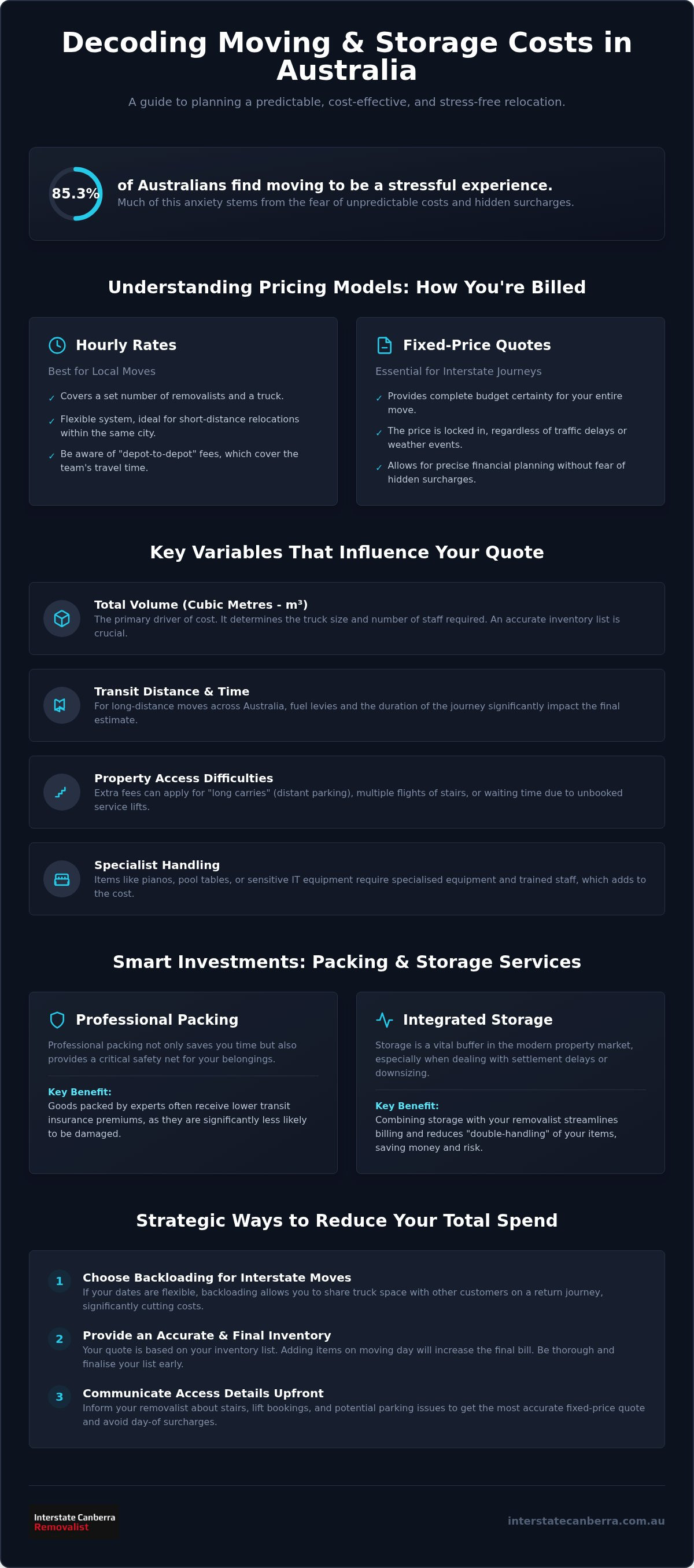
Did you know that 85.3% of Australians find the process of moving to be stressful? Much of this anxiety comes from the fear of the unknown, especially when it comes to unpredictable moving and storage costs. It’s a common worry. You want a seamless transition to your new home or office, but the threat of “cowboy” removalists adding surprise surcharges can make the entire project feel like a gamble.
We agree that you shouldn’t have to deal with budget shocks while managing a major life change. This guide will help you master the variables of Australian relocation so you can plan a professional, cost-effective move. We’ll examine how storage fees interact with moving labour and show you how to protect high-value assets like pianos and IT equipment. You’ll learn how to build a predictable budget that ensures your belongings arrive safely and your finances stay intact. This is your roadmap to a secure and efficient transition anywhere in the country.
Key Takeaways
- Learn the difference between hourly rates for local moves and fixed-price quotes for interstate journeys to avoid surprise surcharges.
- Identify the core variables driving moving and storage costs, such as total volume and transit distance across Australia.
- Discover how integrating professional storage with your removalist streamlines your billing cycles and reduces the risk of double-handling.
- Master strategic ways to lower your total spend, including the use of backloading for cost-effective interstate transitions.
Understanding the Foundation of Moving and Storage Costs
Relocating across Australia requires a clear understanding of how moving and storage costs are structured. These expenses represent more than just a delivery fee. They cover the physical labour of loading, the complex logistics of interstate transit, and the rental of secure facility space. In the modern Australian property market, storage has become a vital buffer. Settlement delays or downsizing often mean your goods need a safe place to wait between keys. The moving industry has evolved to offer various pricing models to suit these different needs, ensuring you only pay for the services you actually use.
To better understand how these expenses are calculated, watch this helpful video:
Hourly Rates vs Fixed Price Quotes
Local moves within a city typically operate on an hourly rate. This usually covers two professional removalists and a fully equipped truck. It is a flexible system, but it relies on efficiency. You should always account for “depot-to-depot” fees. These charges cover the time it takes for the team to travel from their base to your home and back again. For long-distance transitions, fixed-price quotes are the preferred choice. They provide total budget certainty. You won’t need to worry about traffic delays or weather events increasing your final bill. This transparency allows you to manage a large-scale interstate budget without the fear of hidden surcharges.
The Link Between Packing Services and Insurance
Many people overlook transit insurance, yet it is a critical safety net for your assets. Professional packing can actually lower your insurance premiums. Insurers recognise that goods packed by experts are far less likely to suffer damage during transit. While you can buy your own boxes and tape, professional service fees often include high-grade materials that provide superior protection for fragile items. A “Full Pack” service is a time-saving investment for busy families that ensures every item is professionally secured before the truck arrives. By investing in professional packing, you reduce the risk of breakage and streamline the entire claims process if an accident does occur.
Key Variables That Influence Your Removalist Estimates
Calculating moving and storage costs requires a detailed look at your specific inventory. The primary driver of any quote is the total volume of goods, measured in cubic metres. This figure dictates the size of the vehicle required and the number of staff needed for the job. Your inventory list serves as the legal basis for the contract. If you add items on moving day that weren’t on the list, your costs will likely increase. For moves spanning the vast distances of Australia, fuel levies and transit time also play a major role in the final estimate.
Volume and the Cubic Metre Factor
Removalists typically calculate space based on how much of a 20ft or 40ft container your belongings fill. You can estimate this by performing a room-by-room audit of your furniture and cartons. Professional removalists use these precise metrics to ensure they allocate the right resources for your relocation. Accuracy at this stage prevents the frustration of a truck that is too small or a bill that exceeds your initial budget.
Access Difficulties: Lifts, Stairs, and Long Carries
Property access is a variable that often surprises homeowners. If a large truck cannot park within a short distance of your entrance, you may face a “long carry” fee. This covers the extra time and labour required to move items over a greater distance. Similarly, “stair charges” apply when teams must navigate multiple flights of stairs without a lift. When moving into apartment complexes, you must book the service lift in advance. Failure to do so can stall the move and lead to significant waiting time fees. Providing clear details about parking and building access helps keep your budget predictable.
Specialist Handling for Pianos and Heavy Assets
Standard furniture is easy to manage, but heavy or delicate items require expert care. Piano movers use specialised equipment like skids, ramps, and heavy-duty trolleys to protect your instrument. These items require additional labour and specific training to move safely. The Australian Furniture Removers Association sets the standards for this type of specialist handling. Investing in expert care for high-value assets is essential for their protection. If you are planning a complex relocation, you can request a transparent quote to see how these variables apply to your specific needs.
Calculating Storage Rental Fees and Integration Costs
Managing moving and storage costs effectively requires looking at these two services as a single logistical unit. Storage fees in Australia are typically organised into weekly or monthly billing cycles, depending on the provider’s structure. While self-storage units offer a high degree of accessibility, they often lead to the “double handling” trap. This occurs when you pay a removalist to unload your goods into a unit, only to pay for the same labour again months later to reload the truck. You can avoid this by using a removalist who manages their own secure facility, allowing for a more streamlined transition and consolidated billing.
Choosing a single provider for both transit and storage is often the most cost-efficient path. It eliminates the need for multiple contracts and ensures that the team handling your furniture is the same team responsible for its safety in the warehouse. This integration reduces the risk of damage and simplifies the inventory management process. If your move involves a gap between settlement dates, coordinating these services through one office provides the peace of mind that your assets are protected without unnecessary administrative stress.
Short-Term vs Long-Term Storage Pricing
The duration of your storage stay significantly impacts the total rate. Many providers offer discounted monthly rates for long-term commitments, which is ideal for those undertaking extensive renovations or working on overseas assignments. You should also account for “In-and-Out” fees. These are small administrative or labour charges applied when you need to access specific items from your inventory while they are in the facility. Secure, climate-controlled storage is essential for protecting wooden furniture and electronics from the fluctuating Australian humidity and temperature extremes.
The Logistics of “Storage in Transit”
Storage in Transit (SIT) is a specialised service designed for interstate relocations where your new home isn’t ready for immediate delivery. Unlike traditional self-storage, SIT keeps your goods within the removalist’s logistics network, often remaining packed in professional transit containers. This method is highly efficient for short gaps of a few days or weeks. Professional storage solutions simplify the entire process by maintaining a consistent chain of custody for your belongings. To ensure your budget remains on track, contact us for a comprehensive quote that integrates both your moving and storage requirements into one transparent plan.
Strategic Ways to Reduce Your Total Relocation Spend
Minimising your total spend is about logistical strategy, not just finding the lowest hourly rate. To effectively manage moving and storage costs, you should follow a structured 5-step framework. First, perform a rigorous inventory audit. Second, request an integrated quote that combines transit and storage to streamline fees. Third, select mid-week or mid-month dates to avoid peak demand. Fourth, enquire about backloading opportunities for long-distance routes. Finally, secure your booking at least six weeks in advance to lock in current rates. This methodical approach ensures you maintain professional standards without overextending your budget.
Planning ahead allows you to treat your relocation as a series of manageable steps. When you engage with a provider early, you gain the flexibility to choose the most cost-effective windows. This is particularly important for interstate transitions where transit schedules are fixed. By understanding how these variables interact, you can protect your high-value assets while keeping your final bill predictable and transparent.
The Financial Power of Decluttering
Reducing your total volume by 20 per cent can often move your relocation into a smaller truck category. This shift dramatically lowers the base service fee and reduces the number of labour hours required for loading. We recommend performing a “bin, donate, sell” audit three weeks before you request a formal quote. Selling unwanted furniture or appliances on local marketplaces is a practical way to offset the cost of professional packing services. It ensures you only pay to move the items that truly matter in your new space.
Timing and Backloading Opportunities
Backloading is a premier budget-friendly option for interstate relocations. This concept uses the empty space on a truck returning from a previous delivery to carry your goods. You share the transit costs with other customers, which significantly lowers your individual fee compared to a dedicated vehicle. Timing also plays a critical role in your final estimate. Mid-week and mid-month moves are generally more affordable than weekend bookings because demand for crews is lower. If you are coordinating a commercial transition, an office relocation checklist helps you plan months in advance. This foresight allows you to secure off-peak rates and avoid the premium surcharges often applied during the busy end-of-year period.
Take Control of Your Australian Relocation Budget
Mastering your moving and storage costs is the key to a stress-free transition. By integrating your logistics and storage with a single provider, you eliminate the inefficiencies of double handling and administrative overlap. Remember that accuracy in your initial inventory and clear communication regarding property access are your best defences against surprise surcharges. Strategic timing, such as opting for mid-week moves or backloading opportunities, ensures your budget remains disciplined without compromising on service quality.
Whether you’re moving a family home or a complex office setup, professional support provides the security your assets deserve. We offer national Australian coverage for all interstate routes and provide expert handling for specialised items like pianos and fragile office IT equipment. You can get an instant interstate moving and storage quote from Interstate Canberra Removalist today. Our no-obligation transparent quoting process gives you the clarity needed to plan with confidence. Your next chapter across Australia starts with a predictable, professional plan that puts your peace of mind first.
Frequently Asked Questions
What factors influence the cost of an interstate move in Australia?
Interstate relocation costs are primarily driven by the total volume of your goods and the distance between your current home and your destination. Factors such as fuel levies, the weight of your inventory, and the inclusion of specialised items like pianos also play a significant role. Choosing a fixed-price quote is the most effective way to ensure budget certainty for these long-distance routes.
Do removalists charge more for moving on weekends or public holidays?
Yes, many service providers apply surcharges for relocations scheduled on weekends or public holidays. These dates often attract higher labour rates and increased demand. To keep your budget manageable, we recommend booking your move for a mid-week or mid-month window when rates are typically more competitive.
What is the cheapest way to move furniture and store it long-term?
Backloading is often the most cost-effective method for interstate transitions. By sharing truck space with other customers, you significantly reduce your individual transit fees. You can further lower your moving and storage costs by decluttering your home before the inventory stage, which ensures you only pay for the items you truly need.
How are storage rental fees calculated for residential moves?
Storage fees are typically calculated based on the total volume of goods, measured in cubic metres, and the length of the billing cycle. Most Australian providers use weekly or monthly billing cycles. Choosing a removalist-managed facility is often more efficient than self-storage because it reduces the labour costs associated with double handling your belongings.
Are packing materials like boxes and bubble wrap included in the moving quote?
The inclusion of packing materials usually depends on the level of service you select. A “Full Pack” or professional packing service generally includes high-grade boxes, tape, and wrap as part of the fee. If you choose a standard removal service, you may need to purchase these materials separately or check if your provider offers a carton hire scheme.
What happens if the removalist takes longer than the hourly estimate?
If your move is based on an hourly rate, you’ll pay for the actual time the crew spends on the job. This is why accurate inventory lists and clear property access are so important for local moves. Fixed-price quotes protect you from these time-based increases, provided the scope of the work and the items being moved haven’t changed since the initial estimate.