

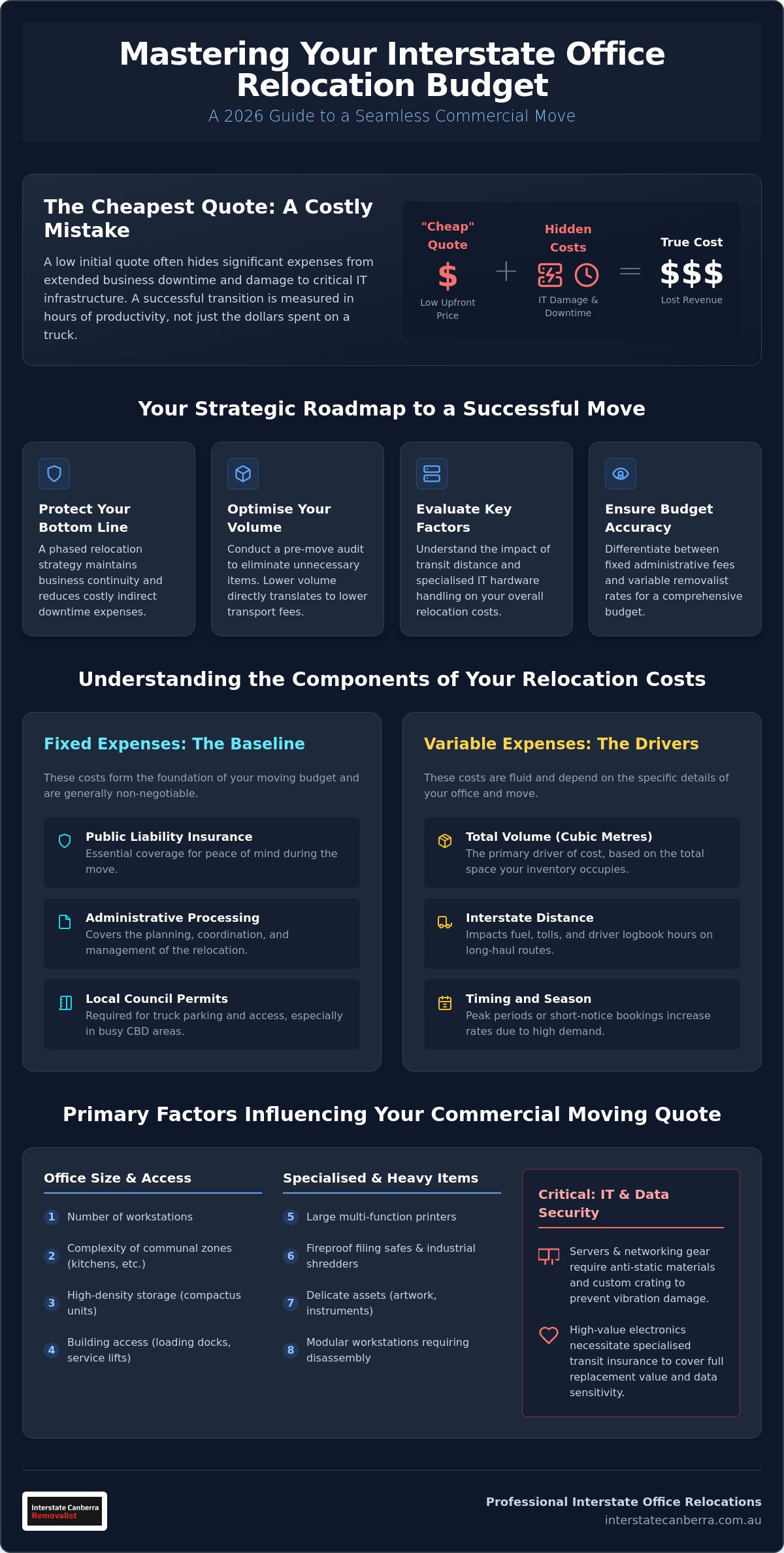
The cheapest quote for your commercial move is often the most expensive mistake your business will ever make. While a low bottom line looks good on paper, it rarely accounts for the hidden price of extended downtime or damaged IT infrastructure. You need a transition that is measured in hours of productivity, not just dollars spent on a truck.
We understand that calculating interstate office relocation costs feels like aiming at a moving target. You are likely balancing the anxiety of variable removalist rates with the absolute necessity of keeping your hardware safe over long distances. It is a complex logistical puzzle, but it does not have to be a source of stress for your leadership team.
This 2026 guide provides the clear budget framework you need to master your moving expenses. We will break down current market rates across Australia, share expert strategies to protect your expensive assets, and outline a plan for a seamless transition to your new premises. You will gain a professional roadmap to move your operations without skipping a beat.
Key Takeaways
- Differentiate between fixed administrative fees and variable removalist rates to ensure your budget is both accurate and comprehensive.
- Evaluate the impact of transit distance and specialised IT hardware handling on your overall interstate office relocation costs.
- Optimise your move by conducting a pre-move audit to eliminate unnecessary volume and lower your total transport fees.
- Protect your bottom line with a phased relocation strategy designed to maintain business continuity and reduce indirect downtime expenses.
Understanding the Components of Interstate Office Relocation Costs
Moving a business across state lines is not simply a scaled-up residential job. It involves a different pricing architecture that prioritises asset protection and minimal disruption. Gaining a deep understanding relocation services helps you see that you are moving a complex system, not just a set of desks. Commercial removals focus on the security of your data and the continuity of your operations.
Your final invoice for interstate office relocation costs depends on how effectively you manage both fixed and variable components. Getting this right early prevents budget blowouts later. It allows you to project a clear financial roadmap for your board or stakeholders.
To help you visualise the factors that drive these expenses, watch this overview of moving costs in Australia:
Fixed vs. Variable Commercial Moving Expenses
Fixed expenses provide the baseline for your move. These include essential public liability insurance, administrative processing, and any local council permits required for truck parking in busy CBD areas. Variable costs are more fluid. They are driven primarily by the total cubic metre (cbm) volume of your inventory and the distance between your origin and destination centres. As of July 2026, rising fuel levies and road tolls are significant factors in every interstate quote. Timing also plays a role; moving during peak periods or on short notice often increases the base rate due to high demand for professional crews.
The Impact of Office Size and Employee Count
The number of workstations usually serves as the primary framework for your labour estimate. However, communal zones often carry hidden complexities. Kitchens, breakout rooms, and high-density storage areas like compactus units require more specialised handling and time to dismantle. Site access is the final piece of the puzzle. If your current or new premises lacks a dedicated loading dock or requires heavy reliance on service elevators, your labour hours will climb. Always check if the truck can park close to the entrance at both ends to avoid additional long-carry fees.
Primary Factors Influencing Your Commercial Moving Quote
Distance is the most obvious driver of your final quote. A move from Canberra to Brisbane involves significantly more transit time and fuel than a local shift. These long-haul routes affect driver logbook hours and vehicle turnaround times. However, the specific nature of your inventory often dictates the total interstate office relocation costs more than the kilometres travelled. You are paying for the expertise required to keep your business assets functional upon arrival.
Protecting your bottom line starts with an accurate inventory. If you want a clear picture of your specific requirements, you can get a tailored quote online to simplify your planning and avoid surprises.
IT Infrastructure and Data Security Logistics
Servers and networking gear are the heart of your business operations. They require more than standard bubble wrap. These assets need anti-static materials and custom crating to prevent vibration damage during several days on the road. High-value electronics also necessitate specialised transit insurance to cover the full replacement value of the hardware and the sensitivity of the data. Utilising professional office packing services ensures your IT infrastructure is handled with the technical precision it requires.
Specialised Equipment and Heavy Item Handling
Large multi-function printers, fireproof filing safes, and industrial shredders add significant weight to a load. These items often require hydraulic tail-lifts or specialised lifting equipment that can influence the daily rate of the crew. Executive suites or reception areas may also contain delicate assets like artwork or instruments. These high-value pieces need piano movers level care to ensure no structural damage occurs during the transition. Professional handling prevents the costly repairs that often follow a DIY or budget-rate attempt.
Modular workstations and custom office furniture are additional cost multipliers. Dismantling and reassembling these units takes time and specific tools. If your new premises has a different layout, the labour hours required to adapt these pieces will climb. Moving interstate involves more than just physical lifting. You must also account for the financial and legal considerations of shifting your business operations between Australian states, ensuring your assets are protected every step of the way.
Strategies to Optimise Your Office Relocation Budget
Reducing the physical volume of your inventory is the most direct way to lower your interstate office relocation costs. Every cubic metre counts. Transport fees add up quickly. A pre-move audit saves thousands. Before you request a final quote, conduct a rigorous audit of your current premises to identify what truly needs to travel across state lines. Transporting empty desks or outdated hardware is a waste of your commercial budget. Don’t waste your resources moving items that won’t serve your new workspace.
Inventory Management and Decluttering
Create a clear checklist for your department heads. Focus on identifying redundant workstations, obsolete hardware, and physical files that are no longer active. Digitising your records before the move eliminates the need to transport heavy filing cabinets; it also reduces your future storage footprint. Consider the return on investment of selling older assets locally. Often, the cost of moving an aged printer or desk interstate exceeds its market value. Selling these items allows you to reinvest that capital into your new fit-out. With office fit-out costs in Canberra averaging $2,938 per square metre in 2026, every dollar saved on transport helps your bottom line.
Professional Packing vs. Internal Resource Allocation
Assigning packing duties to your own staff often seems like a cost-saving measure. However, the hidden productivity loss tells a different story. When you factor in staff salaries and the halt in their primary roles, the ‘free’ labour becomes quite expensive. Professional crews work with speed and precision. They use industry-standard materials to protect fragile assets. This significantly reduces the risk of transit damage and the overall interstate office relocation costs associated with insurance claims. Review our office relocation checklist to see how professional packing fits into a streamlined transition timeline.
For non-essential items or surplus stock, consider the benefits of backloading. This involves using the available space in a truck already scheduled for an interstate route. It offers a lower price point for less urgent goods. Timing is also a critical factor. Relocating during quieter months or mid-week can often help you secure more competitive rates from premium removalists. Many businesses are currently moving to regional centres to take advantage of operating cost savings between 20% and 60%. If you are part of this trend, contact our team for a detailed quote to see how we can make your transition more cost-effective.
Minimising Business Downtime and Indirect Relocation Expenses
The true price of an office move isn’t just the figure on your removalist’s invoice. It is the revenue lost when your team cannot access their tools or serve your clients. If your business generates $10,000 in daily revenue, a three-day delay represents a $30,000 hit to your bottom line. This loss of productivity is often the largest hidden variable in interstate office relocation costs. You must account for this operational “blackout” period when planning your total budget.
Direct expenses like truck hire and labour are easy to track, but indirect expenses are harder to pin down. A poorly planned transition can lead to days of operational silence. You need a strategy that keeps your revenue streams active while your physical assets are in transit across state lines. Professional planning ensures that your return to work is measured in hours, not weeks.
Phased Moving and Business Continuity
Moving in stages is the most effective way to maintain continuity. You might relocate your IT and support teams first to ensure the digital infrastructure is ready at the destination. Meanwhile, your sales team remains at the original site to handle client enquiries. This “skeleton office” approach prevents a total blackout of your services. Clear communication is vital during this period. Inform your clients of the move dates early and provide temporary contact details to ensure they feel supported throughout your transition.
Strategic Use of Storage Solutions
Gaps between commercial leases are common in the Australian market, especially with current regional migration trends showing a 32% to 36% increase in businesses moving away from major capitals. Secure, short-term storage allows you to vacate your old premises on time without rushing the setup of the new one. This is particularly useful if your new fit-out is still being finalised. High-security storage is essential for sensitive business data and physical archives. Off-site solutions are also cost-effective for non-critical assets that don’t need to be unpacked on day one. By staggering the delivery of your inventory, you can organise your new space more efficiently and reduce the pressure on your staff.
Choosing the right partners is the final step in protecting your budget. Experienced removalists understand that speed and security are non-negotiable. They focus on getting your team back to work as quickly as possible. This reduces the total impact of interstate office relocation costs on your annual performance and ensures a seamless transition for your clientele.
Secure Your Business Future with a Seamless Move
A successful interstate transition is defined by preparation and the protection of your commercial assets. You have seen how a rigorous inventory audit and a phased relocation strategy can keep your team productive while your hardware travels across state lines. Balancing interstate office relocation costs is about making smart investments in professional expertise to prevent expensive downtime.
Our team provides the steady hand you need for a complex logistical shift. We offer nationwide interstate coverage and professional packing services to ensure your equipment arrives ready for immediate use. If your new premises isn’t ready yet, our secure storage for sensitive assets provides the flexibility your business requires. We take pride in delivering a transition that is as efficient as it is secure.
Take the first step toward your new office location without the stress of hidden fees. Get an instant commercial relocation quote today and focus on growing your business in your new home. Your next successful chapter starts with a reliable partner by your side.
Frequently Asked Questions
How is the cost of an interstate office relocation calculated in Australia?
Costs are calculated primarily based on the total cubic metre volume of your inventory and the transit distance between your origin and destination centres. Removalists also factor in the total labour hours required for dismantling furniture and loading the vehicle. Accessibility at both sites, such as the availability of loading docks or service lifts, will influence the final complexity and price of the quote.
What are the hidden costs to watch out for during a commercial move?
Hidden expenses often include council parking permits for CBD loading zones and long-carry fees if the truck cannot park close to your office entrance. You might also encounter stair fees if elevators are unavailable or surcharges for moves scheduled on public holidays. Always confirm whether fuel levies and road tolls are included in your initial estimate for interstate office relocation costs to ensure your budget remains accurate.
Does the move price include the packing of IT equipment and servers?
Specialised packing for IT infrastructure and server rooms is typically an add-on service rather than a standard inclusion. This ensures your sensitive hardware is protected with anti-static materials and custom crating designed for long-haul transit. Requesting this specific service allows the removalist team to allocate the correct technical expertise and materials to safeguard your data security and hardware integrity.
How can our business reduce the total volume of goods for an interstate move?
Reducing volume starts with a rigorous pre-move audit to identify redundant workstations and obsolete hardware. Digitising physical archives before you relocate eliminates the need to transport heavy filing cabinets across state lines. Selling aged assets locally and reinvesting that capital into your new office fit-out is often more cost-effective than paying for the transport of items that are nearing the end of their lifecycle.
Is transit insurance included in the standard office removalist quote?
Standard quotes usually provide public liability insurance, but comprehensive transit insurance is often a separate, essential cost. This specific coverage protects your commercial assets against damage or loss during the actual journey between states. It is vital to review the Product Disclosure Statement to ensure your high-value electronics and executive furniture are protected for their full replacement value throughout the transition.
What is the average duration of a large-scale interstate office relocation?
A large-scale move typically spans three to five business days depending on the transit distance and the volume of goods. This timeframe includes the initial packing phase, the long-haul journey between major centres, and the final unpacking at your new premises. Implementing a phased relocation strategy can help your business maintain operational continuity while the physical transition is being completed by your removalist team.