

A grand piano isn’t just a heavy piece of furniture; it is a complex engineering marvel with over 12,000 individual parts held under immense tension. Entrusting such a delicate instrument to general removalists often leads to sleepless nights and valid fears about soundboard damage. You need a strategy that treats your instrument with the reverence it deserves during piano transport.
We understand that the cost of specialist movers and the logistics of climate care can feel overwhelming. You want a relocation that’s entirely damage-free without overpaying for unnecessary extras. This guide provides the professional clarity you need to organise the move of your instrument across the country with confidence.
You will learn how to identify the specialist equipment required for grand pianos, how to prepare the casing for a long journey, and why climate-controlled transport is non-negotiable in 2026. We have distilled the technical requirements into a straightforward plan to ensure your instrument arrives ready for its next performance.
Key Takeaways
- Learn why professional handling is the only way to protect your instrument’s delicate internal mechanics during a relocation.
- Identify the specific vehicle features, like Air-Ride suspension, that are required to neutralise damaging road vibrations.
- Master the “clear path” protocol to ensure your home is ready for the logistical challenges of moving a grand piano.
- Discover how to vet a piano transport provider to ensure they have the correct credentials and specialist equipment.
- Gain a step-by-step framework for preparing your instrument for a safe, long-distance journey across Australia.
Why Specialist Piano Transport is Non-Negotiable
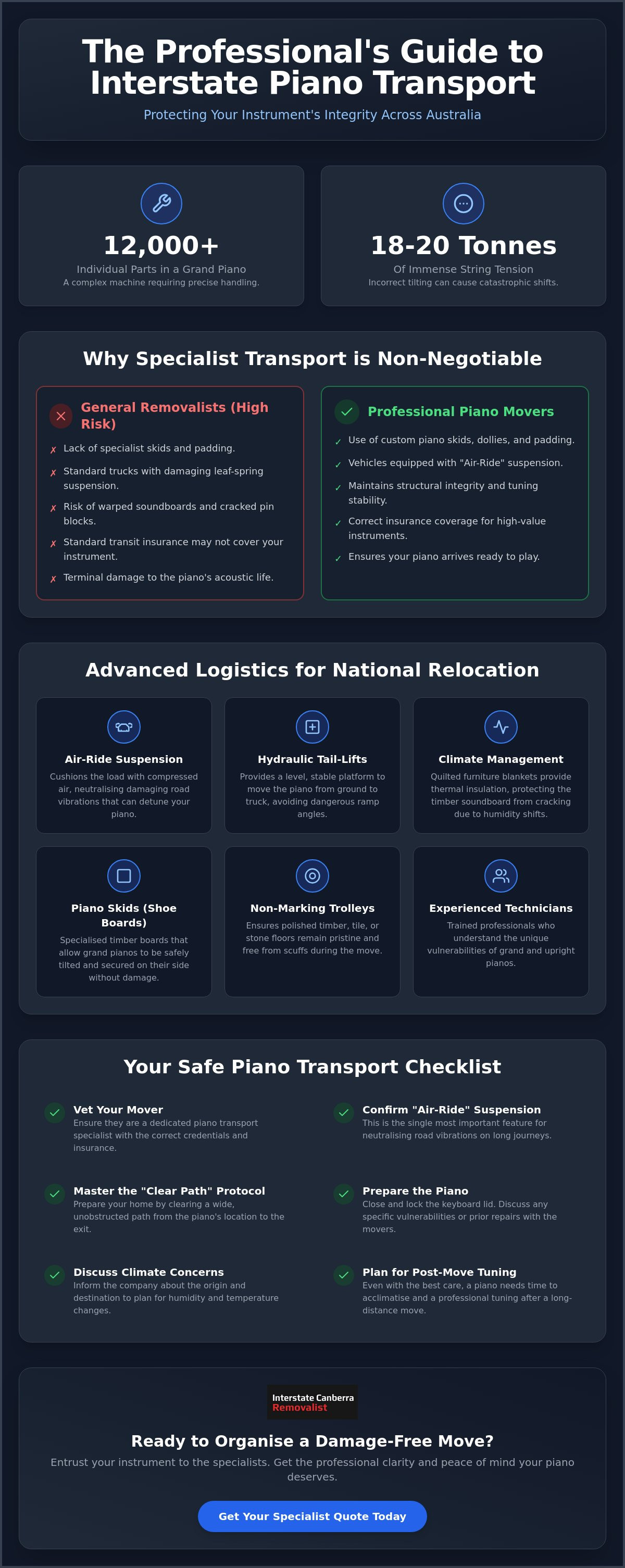
Piano transport is a highly specialised branch of logistics that deals with instruments under extreme physical stress. It isn’t just about managing weight; it’s about managing tension. A typical piano holds roughly 18 to 20 tonnes of string tension across its internal cast-iron plate. If the instrument is tilted or handled incorrectly, this tension can shift violently, causing permanent structural damage.
Choosing a general removalist over a dedicated piano removalist often leads to expensive mistakes. While general movers are skilled with household furniture, they rarely possess the specialised skids or padding required for high-value instruments. Improper handling can lead to warped soundboards or cracked pin blocks, which are often terminal for the instrument’s acoustic life.
To better understand this concept, watch this helpful video:
For a deeper look at the technical stages involved, Wikipedia’s Guide to Moving a Piano details the specific tools like piano boards and heavy-duty dollies used to maintain structural integrity. Without these specialist tools, you risk damage that a simple tuning cannot fix. Expert piano transport ensures the instrument remains stable throughout the entire journey.
The Mechanical Vulnerability of Grand and Upright Pianos
Upright pianos use a vertical action where hammers move horizontally. In contrast, grand pianos rely on a gravity-fed action. This makes grand pianos particularly vulnerable when they are turned on their sides for transport. The lyre, which houses the pedals, and the delicate legs are the most common points of failure during a move. Sympathetic vibration occurs when the instrument’s strings resonate in response to external road frequencies, which can loosen the tuning pins over a long journey if the piano isn’t properly dampened.
The Financial and Sentimental Cost of Poor Handling
The financial stakes are high. Structural damage can instantly wipe thousands of dollars off an instrument’s resale value. Many owners don’t realise that standard transit insurance often excludes specialist items if they aren’t professionally packed by experts. Hiring professional piano movers ensures your investment is protected by experts who understand these specific insurance requirements. It provides the peace of mind that your piano will arrive in the same condition it left, ready to be played.
Advanced Logistics for National Piano Relocation
Moving a piano across state lines requires more than just a big truck. Standard leaf-spring suspension found in most freight vehicles is too rigid for delicate instruments. Professional piano transport relies on “Air-Ride” suspension. This technology uses compressed air to cushion the load, neutralising road vibrations that would otherwise rattle tuning pins loose or damage the internal action. It’s the difference between a smooth journey and a costly repair bill.
Loading techniques are equally critical. We avoid manual ramp loading because the steep angles can destabilise a heavy instrument. Heavy-duty hydraulic tail-lifts provide a level, stable platform that keeps the piano perfectly upright during the transition from the ground to the truck deck. For grand pianos, we utilise “Piano Skids” (also known as shoe boards). These timber boards allow the instrument to be safely tilted and secured on its side without risking the polished casing. Every trolley in our kit features non-marking rubber wheels. This ensures your polished jarrah or tile floors remain pristine throughout the process.
Climate Control and Humidity Management
Australia’s geography presents unique challenges for timber instruments. Moving a piano from the tropical humidity of the Sunshine Coast to the dry winter air of Canberra can cause the soundboard to contract and crack. We use heavy-duty quilted furniture blankets to provide a vital layer of thermal insulation. For multi-day national trips, maintaining a stable environment is essential. If you are moving between major hubs, our Canberra to Sydney service provides the specialised handling required to manage these environmental shifts safely.
Specialist Equipment: Beyond the Standard Trolley
Standard moving gear isn’t enough for high-tension instruments. Upright pianos often require an “A-frame” support to prevent them from tipping during transit. For grand pianos, “Lyre blocks” are used to support the pedal assembly, which is famously fragile and prone to snapping under its own weight. The Piano Technicians Guild emphasises that even minor internal shifts can lead to significant mechanical issues. We use high-tensile strapping systems to lock the instrument into the vehicle’s tracking, ensuring zero movement regardless of the road conditions or distance travelled. For a broader understanding of the systems and equipment used to move oversized goods safely, our guide to professional heavy item movers outlines the complete range of strategies employed by specialist teams.
How to Organise and Prepare Your Piano for Transport
Efficiency begins long before the truck arrives at your driveway. Adopting a strict “clear path” protocol is the first step toward a damage-free relocation. Remove loose rugs that present trip hazards. Take down wall art and move furniture into other rooms to create a wide, unobstructed lane. This allows the team to focus entirely on the weight of the instrument rather than dodging obstacles in tight spaces.
Measure the “swing space” in every hallway and doorway. A piano doesn’t move in a straight line; it needs a wide arc to pivot around corners. Account for the length of the piano and the clearance required for the movers to stand on either side. Before the team arrives, capture high-resolution “pre-move” photographs of the casing and internal action. This documentation is vital for insurance purposes. Finally, ensure the fallboard (the keyboard lid) is locked. If your key is missing, use low-tack painter’s tape to secure the lid without damaging the finish during piano transport.
Assessing Access Points and Terrain
Every obstacle on your property changes the logistics of the move. Identify stairs, internal door lips, and gravel paths early. “Stair-hopping” is a high-risk manoeuvre that requires a minimum of three specialist movers to ensure the centre of gravity remains stable. If you are in an apartment, verify the lift dimensions and weight capacity. Providing this data to your piano moving company ensures they arrive with the correct equipment, such as ramps or specialised stair-climbing dollies.
Documentation and Risk Mitigation
Verify that your insurance policy covers “mechanical derangement.” This specific clause protects you if the internal action malfunctions after the journey, even if there is no external damage. Always sign a “Condition Report” with the moving lead at pick-up to confirm the instrument’s state. One final rule: never allow a piano to be moved on its internal “caster” wheels. These small wheels are designed for minor adjustments on a flat stage, not for rolling across a house. Using them for transport can snap the legs or permanently gouge your flooring.
Ready to secure your instrument’s future? Organise your professional piano transport today.
Selecting a Trusted National Moving Partner
Choosing the right partner for piano transport is the final hurdle in ensuring your instrument’s safety. Many general carriers offer low-cost quotes, but these usually indicate a lack of specialist equipment or insufficient insurance coverage. A professional piano move requires a specific set of credentials that go beyond standard furniture handling. You aren’t just paying for the heavy lifting; you’re paying for the technical expertise required to manage 18 tonnes of internal tension safely.
If you are moving interstate, national reach is essential. Long-distance journeys involve multiple climate zones and varying road conditions, making a proven track record vital. Check recent reviews specifically for “heavy item” or “piano” transport rather than general house moves. A company that consistently handles grand pianos will have the logistics and specialised vehicles needed for a seamless transition across state lines.
Evaluating Equipment and Training Standards
Don’t be afraid to ask direct questions before booking. Ask if the team uses a dedicated piano skid and how many men will be assigned to the lift. An in-house specialist team is always preferable to sub-contracted drivers who may lack specific training in piano mechanics. If your new home isn’t ready immediately, look for providers that offer integrated storage solutions. This ensures your instrument remains in a climate-controlled environment rather than sitting in a standard warehouse during settlement gaps.
Post-Transport Care: The Acclimatisation Period
Once your piano arrives, the journey isn’t quite over. A piano must “settle” in its new environment for at least 2 to 4 weeks before you book its first tuning. The timber needs time to adjust to the new room’s micro-climate, including changes in humidity and temperature. Tuning it too early is a wasted effort, as the wood will continue to expand or contract as it acclimates to the new space.
On the day of delivery, follow this final checklist to ensure a successful handover:
- Inspect the casing immediately for any new scratches or pressure marks.
- Check the pedal lyre to ensure it is firm and responsive.
- Test every key to confirm the internal action hasn’t been affected by vibration.
- Sign off the condition report only once you’ve completed a thorough visual and tactile inspection.
By following these steps, you protect both the financial value and the musical soul of your instrument. Professional piano transport provides the steady hand you need to navigate the complexities of national relocation with total confidence.
Secure Your Instrument’s Musical Future
Moving a high-tension instrument requires a level of precision that general removalists simply cannot provide. You now understand the technical necessity of Air-Ride suspension and the critical role of specialist equipment like piano skids and lyre blocks. By following the “clear path” protocol and allowing for a proper acclimatisation period, you ensure your piano remains a valuable asset for years to come.
Don’t leave your instrument’s safety to chance during a long-distance move. Our expert teams are specifically trained in grand and upright piano handling, supported by a fully insured national transport network. We utilise specialist heavy item movers equipment on every job to maintain structural integrity and provide you with total peace of mind during piano transport.
Ready to move? Get a specialist piano transport quote from Interstate Canberra Removalist today. Your instrument is in safe hands, and we look forward to helping you settle into your new home with your music intact.
Frequently Asked Questions
How much does it cost to move a piano interstate in Australia?
Pricing for interstate relocations depends on the instrument’s weight, dimensions, and the complexity of access at both ends. Factors such as the number of staircases, the requirement for a crane, and the total distance between cities like Canberra and Brisbane will influence the final quote. Professional piano transport providers calculate these costs based on the specific equipment and man-hours required to ensure a zero-damage outcome.
Do I need to tune my piano immediately after it is moved?
You should wait at least two to four weeks before booking a tuner for your instrument. A piano needs this time to settle and acclimatise to the humidity and temperature levels of its new environment. Tuning it immediately after delivery is often a waste of money. The timber soundboard will continue to expand or contract as it adjusts to the new room’s micro-climate.
Can a regular removalist move a baby grand piano?
While general removalists are skilled with household furniture, they often lack the specialised skids and padding required to handle a baby grand safely. Moving a grand piano involves removing the legs and lyre, then securing the body on its side using a dedicated piano board. Without this specific training and equipment, the risk of structural damage to the internal action or the polished casing is significantly higher.
What is the safest way to transport a piano over a long distance?
The safest method involves hiring a specialist team that utilises vehicles equipped with Air-Ride suspension and hydraulic tail-lifts. This configuration minimises road vibrations that can rattle tuning pins and internal components. High-tensile strapping and thermal quilting are essential to secure the instrument and protect it from Australia’s extreme temperature shifts during piano transport.
Is it possible to move a piano on its side?
Grand pianos are designed to be transported on their sides once the legs and pedals have been professionally removed and the body is secured to a piano skid. However, upright pianos must always be moved in a vertical position. Tilting an upright piano on its side can cause the internal hammers and dampers to shift out of alignment, leading to expensive mechanical repairs.
How many people are required to safely move an upright piano?
A standard upright piano move typically requires a minimum of two specialist movers on flat ground. If the move involves navigating staircases or steep ramps, a team of three or four is necessary to manage the weight and maintain a stable centre of gravity. Having sufficient manpower ensures the safety of both the instrument and the removalist team during the lifting process.