

Most interstate moving quotes are designed to look simple on the surface, but the real cost often hides in the fine print of fuel levies and depot fees. Understanding interstate moving costs Australia wide is a source of frustration for many, especially when you’re met with vague estimates that leave room for unexpected surcharges. It’s a confusing process that adds unnecessary anxiety to a major life transition. You need a clear, dependable breakdown of what you’re actually paying for.
We believe that transparency is the only way to manage a successful relocation. You deserve to know exactly how removalists calculate their fees and which variables impact your final invoice. This guide provides a professional framework to help you master the logistics of interstate pricing. We’ll show you how to compare backloading against full-service moves and identify practical ways to lower your total costs without sacrificing the safety of your belongings. By the end of this article, you’ll have the tools to secure a fair, professional quote that protects your budget and your peace of mind.
Key Takeaways
- Understand how modern removalists calculate fees using cubic metres rather than weight to ensure your inventory assessment is accurate.
- Identify the primary factors driving interstate moving costs Australia wide, including route distance and the logistical difference between major cities and regional centres.
- Compare the benefits of backloading against full-service relocations to determine the most efficient option for your specific timeline and budget.
- Discover practical strategies to lower your final quote by downsizing your belongings and choosing between professional packing or DIY preparation.
- Learn how to spot hidden surcharges like fuel levies and depot fees to maintain total transparency throughout your entire relocation process.
Deciphering Interstate Moving Costs: A 2026 Pricing Overview
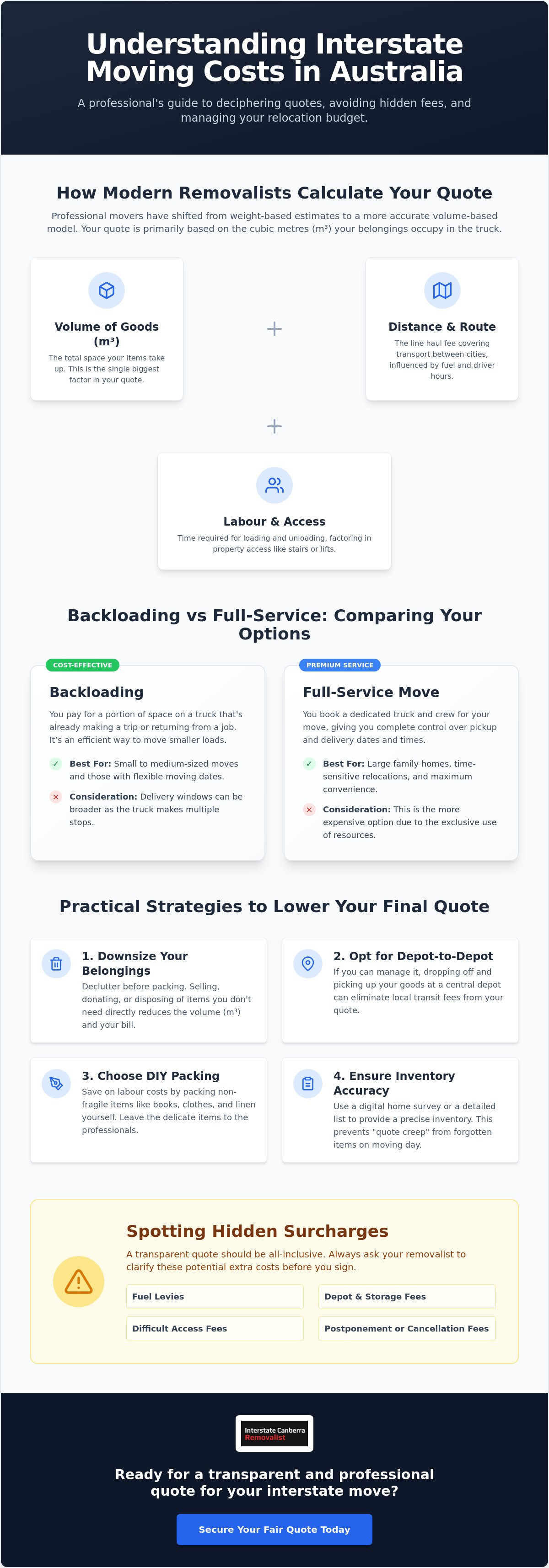
Calculating interstate moving costs Australia wide requires a look at three core pillars: volume, distance, and the labour hours required for loading. In 2026, market conditions like fluctuating diesel prices and national infrastructure updates play a heavy role in setting the base rate for any long-distance relocation. The efficiency of Australia’s road transport network directly dictates how quickly a truck moves between major hubs, which in turn influences your final quote. Most professional removalists have shifted away from traditional weight-based estimates in favour of volume-based pricing. It’s a more predictable model that allows for better space management inside the vehicle.
Cubic metres (m3) represent the total three-dimensional space your belongings occupy inside a truck and serve as the standard unit for Australian removalist quotes. This shift ensures you only pay for the specific portion of the trailer your items fill. Understanding this measurement is the first step toward controlling your moving budget.
To better understand this concept, watch this helpful video:
The Basic Formula for Interstate Relocation Fees
The primary component of interstate moving costs Australia is the line haul fee. This covers the actual transport of goods between cities. Unlike local metropolitan shifts that typically charge by the hour, interstate moves use a distance and volume logic. Choosing a door-to-door service provides the most convenience, but some budget-conscious movers opt for depot-to-depot service to reduce the total price. This requires you to drop off and pick up your items at a central warehouse, effectively removing the local transit legs from the removalist’s responsibility.
Inventory Accuracy and Its Impact on Price
Your inventory list is the most important document in the quoting process. An accurate list prevents “quote creep” where the price rises on moving day because the truck is suddenly too small. Many people overlook items in the garden shed, garage workbenches, or large outdoor pots. These “forgotten” items quickly add several cubic metres to the load. To solve this, digital home surveys have largely replaced manual walkthroughs. You can now use your smartphone to film each room, allowing a consultant to provide a fast, precise estimate without needing to visit your property in person.
Primary Drivers of Your Australian Relocation Quote
While volume provides the baseline for interstate moving costs Australia wide, several logistical variables determine the final figure on your quote. Professional removalists assess the complexity of a move beyond just the number of boxes. For instance, moving a three-bedroom home from a ground-floor property is a straightforward task compared to a similar volume move from a high-rise apartment with restricted lift access. Accessibility issues like steep driveways, narrow inner-city streets, or long carries from the front door to the truck add significant labour hours. It’s vital to understand your consumer rights when moving to ensure your quote is transparent and includes these potential surcharges upfront.
Speciality items also play a major role in the pricing structure. Heavy or delicate belongings, such as grand pianos, billiard tables, or high-value artwork, require bespoke handling and often additional manpower. These aren’t standard items that can be stacked easily; they require specific equipment and securing techniques to survive long transits. If you have complex items, it’s worth consulting a specialist grand piano mover to ensure the safety of your investment while maintaining a clear budget.
Distance and Regional Access Surcharges
Route efficiency is a massive factor in Australian logistics. High-traffic corridors between capital cities, such as the Sydney to Melbourne run, are generally more cost-effective because trucks travel these routes daily. In contrast, regional or remote locations often involve ‘dead legs’ where a truck may have to return empty or travel hundreds of kilometres off the main highway. This increases the base rate to cover additional fuel and driver hours. You should also account for road tolls and fuel levies, which are standard inclusions that fluctuate based on 2026 market rates. Moves involving regional centres typically require more precise scheduling to align with existing transport lanes.
Timing, Seasonality, and Demand Peaks
When you choose to relocate is just as important as the distance you’re travelling. Demand for interstate movers peaks significantly between November and January. Moving during the summer school holidays can increase costs by 20% to 30% due to the sheer volume of families relocating at the same time. You can often secure lower rates by scheduling your move for mid-week or mid-month. Most people prefer the first or last day of the month to align with lease handovers, which creates a bottleneck. Booking your service at least 4-6 weeks in advance is the most reliable way to lock in a competitive price and ensure your preferred dates are available.
Backloading vs Full-Service: Comparing Your Moving Options
Choosing between backloading and a full-service move is the most significant decision affecting your final bill. Both options offer professional care, but they serve very different logistical needs. When researching interstate moving costs Australia wide, you’ll find that the service tier you select is just as impactful as the total volume of your goods. Understanding these differences helps you align your budget with your required level of control over the transit schedule.
The Value Proposition of Backloading
Backloading is a highly cost-effective way to relocate across state lines. It involves booking the unused space in a truck that’s already travelling to your destination. This method significantly lowers the price tag because you only pay for the specific portion of the trailer you occupy. It’s also a greener choice. It reduces the number of half-empty vehicles on the road by consolidating multiple smaller loads into a single trip.
Backloading requires a degree of flexibility. Since you’re sharing space, your pickup and delivery dates are often dictated by the truck’s primary route and existing bookings. This makes it an ideal solution for students, small apartment moves, or anyone with a loose timeline. When moving interstate, you must also consider interstate quarantine laws, which apply regardless of whether you choose a shared or dedicated vehicle.
Full-Service Removals: When Speed and Security Matter
A full-service move provides a dedicated truck solely for your belongings. This is the gold standard for large family homes or high-value relocations where a strict schedule is non-negotiable. You get direct transit from door to door. The truck doesn’t stop to load or unload other clients’ items along the way, which reduces handling and provides the highest level of security for your property. It’s the most efficient path for a moving household relocation of any size.
Speciality items often demand this level of service. For example, professional piano movers typically require a dedicated vehicle environment. This ensures the instrument is properly secured and isn’t at risk from shifting cargo in a shared load. While the upfront investment is higher, the certainty of a fixed delivery window and reduced handling is often essential for busy professionals. Ready to find the right fit for your home? Request a transparent quote from our specialist team today.
Minimising Expenses and Securing Your Final Quote
While you cannot change the distance between your old home and your new one, you have total control over the volume of goods you transport. Reducing your inventory is the most direct way to lower interstate moving costs Australia wide. Every cubic metre you remove from your manifest represents a tangible saving on your final invoice. By focusing on volume reduction and smart labour choices, you can maintain a professional service level while keeping your budget intact.
Labour is the second largest variable in your quote. Choosing between professional packing and DIY box preparation is a balance of time versus money. While professional packing ensures maximum security and often qualifies you for better insurance coverage, doing the work yourself can significantly cut the total labour hours billed. If you choose the DIY route, ensure you use industry-standard double-walled boxes to prevent damage during the long interstate haul. Regardless of who packs the boxes, transit insurance remains a non-negotiable expense. It provides the essential safety net required for long-distance logistics where road conditions and vibrations are unpredictable.
The ‘Declutter for Dollars’ Strategy
Organising your belongings before the removalists arrive is a high-return activity. Follow this three-step guide to trim your move:
- Sort by Necessity: Categorise every item into ‘keep’, ‘sell’, or ‘donate’. If you haven’t used an item in the last year, it’s likely not worth the cost of interstate transport.
- Target Heavy Furniture: Bulky, low-value items like old particle-board bookshelves or worn-out appliances often cost more to move than they are worth. Sell these locally and buy new ones at your destination.
- Audit Your Inventory: Use a comprehensive moving checklist to track exactly what stays and what goes. This prevents last-minute additions that could trigger extra fees on moving day.
Evaluating Quotes and Avoiding Hidden Fees
Securing a fair price requires a keen eye for detail. Be wary of ‘too good to be true’ quotes from unlicensed operators; these often lead to surprise charges or poor handling. Always ask if the quote includes GST, fuel levies, and any potential surcharges for heavy items. For long-distance relocations, a fixed-price quote is almost always superior to an hourly rate. Fixed pricing provides certainty, protecting you from costs associated with traffic delays or slow loading times. Before signing, ensure the contract clearly outlines the service scope, including any storage solutions if your new home isn’t ready for immediate move-in. If you want a complete step-by-step system for moving household with zero surprises, our ultimate Australian relocation guide covers everything from early decluttering to final bond preparation. This level of transparency ensures your relocation remains a calm, professional experience from start to finish.
Secure a Seamless Transition for Your Move
Mastering the variables of interstate moving costs Australia wide puts you in the driver’s seat of your relocation. You now understand that accurate inventory management and choosing between backloading and full-service moves are the most effective ways to protect your budget. By decluttering early and securing a fixed-price contract, you eliminate the risk of hidden surcharges and ensure a transparent experience from start to finish.
Our team is here to manage the heavy lifting and logistical complexities for you. We provide professional packing and unpacking services, specialised piano and heavy item transport, and secure storage solutions for long-distance transitions. Whether you’re moving a small apartment or a large family home, we offer the steady hand you need for a stress-free shift.
Get an instant, transparent interstate moving quote today and take the first step toward your new home with confidence. Your next chapter deserves a professional start.
Frequently Asked Questions
How much does it cost to move interstate in Australia on average?
Total interstate moving costs Australia wide depend primarily on the distance between your load and unload points and the total volume of your belongings. While industry figures fluctuate based on seasonal demand, a three-bedroom home relocation typically requires a larger budget than a small unit move. You should request a fixed-price quote to ensure all transit logistics and labour are covered without surprises.
What is the cheapest way to move furniture between states?
Backloading is typically the most cost-effective method for furniture transport between states. By sharing the space in a truck already travelling your route, you avoid paying for the entire vehicle’s operation. This is an excellent solution for those with flexible dates who want to lower their total expenses without sacrificing professional handling during the journey.
Do interstate removalists charge by weight or volume?
Most Australian removalists now charge based on volume, measured in cubic metres, rather than weight. This model is more accurate for long-distance transport because truck capacity is limited by physical space. An accurate inventory list ensures you only pay for the specific area your items occupy inside the trailer, allowing for better logistical planning.
Are there hidden fees like fuel levies in moving quotes?
Professional quotes should be transparent, but you must check for line items like fuel levies, road tolls, and difficult access surcharges. Some operators might exclude these from a low initial estimate, leading to higher costs on moving day. Always confirm that your final contract is inclusive of all standard transit fees before you sign.
Is transit insurance included in the standard moving cost?
Basic transit insurance is often a separate addition to the standard moving fee and is highly recommended for long-distance relocations. It provides a necessary safety net against unforeseen events during transit, such as road accidents or extreme weather. Check with your provider to see if they offer comprehensive cover or if you need to arrange a policy independently.
How much does it cost to move a piano interstate in 2026?
Moving a piano interstate is a specialised service that requires a bespoke quote based on the instrument’s type and the access conditions at both properties. Because of the weight and fragility involved, these items require specific equipment and additional manpower to transport safely. Requesting a dedicated quote for your grand or upright piano ensures it receives the necessary protection throughout the journey.